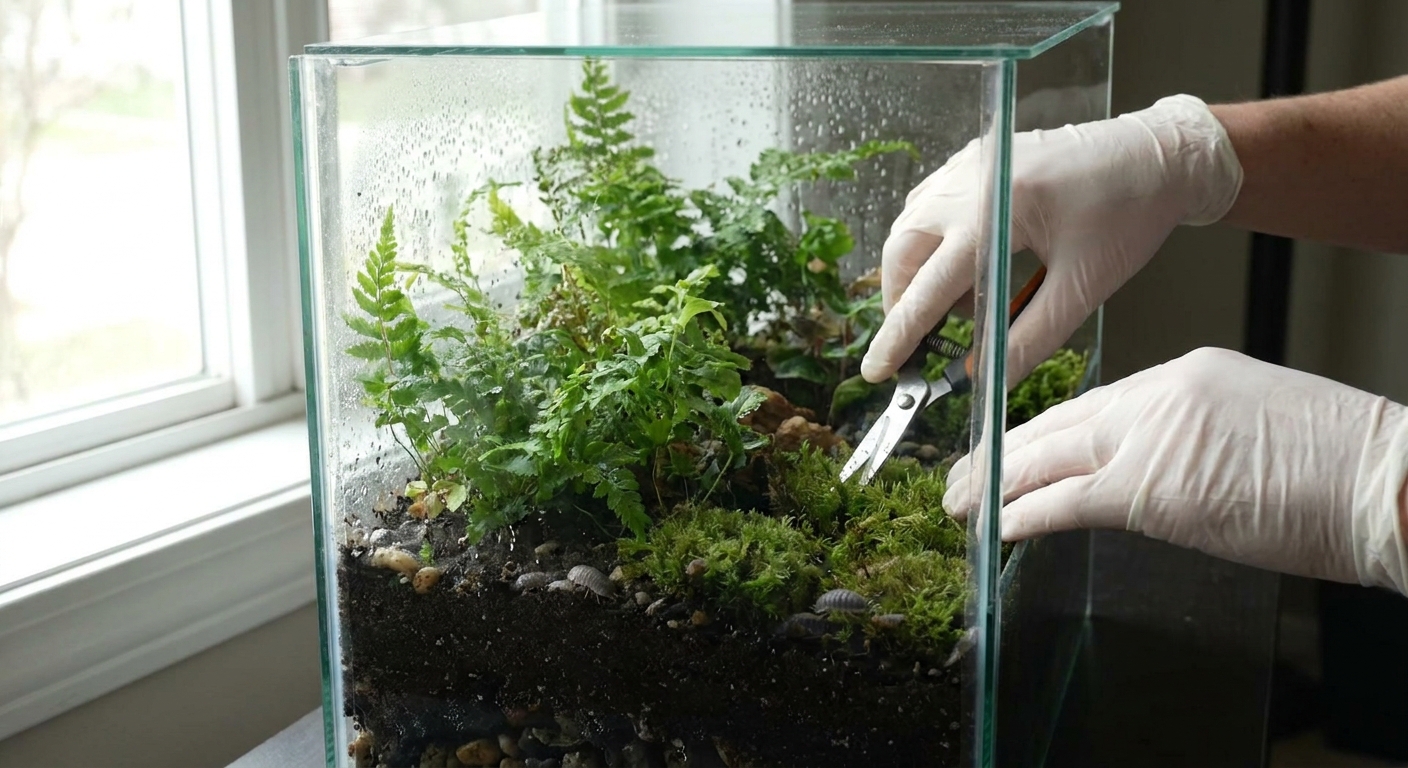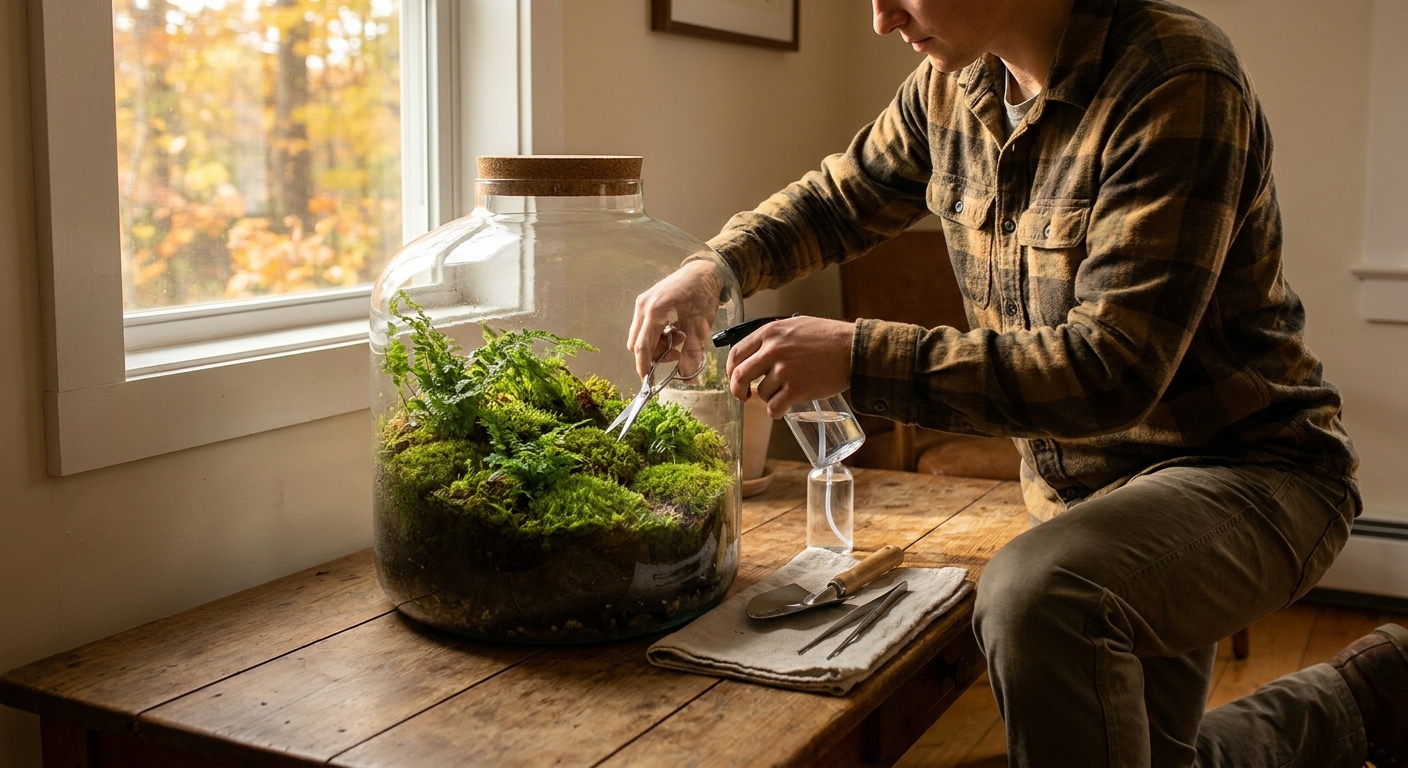
Maintenance in a terrarium or vivarium isn’t a chore; it’s a quiet conversation with a tiny climate. Step close: the glass is cool, your breath fogs the surface, and inside a miniature forest exhales. Good care means learning to read this little biome and tuning it, season by season, so it grows more stable and beautiful with time.
Tending the World Behind Glass
This guide walks you through a hands-on, sensory-rich maintenance ritual you can repeat every few weeks to keep your living glass ecosystems thriving.
1. The Five-Minute Visual Checkup
Before tools or tweaks, observe.
Stand in front of the enclosure and scan from substrate to canopy:
- Glass: Is there light, even dew on the walls, or heavy condensation streaming down? Is algae coating the lower panes?
- Plants: Are leaves upright and turgid or drooping and thin? Any yellowing, spotting, or mushy stems?
- Mosses: Are cushions springy and bright, or flat, brown-edged, and dusty-looking?
- Substrate: Is it evenly moist, or are there cracked, dry patches or areas of swampy, standing water?
- Cleanup crew (if bioactive): Can you spot isopods, springtails, or other detritivores moving when you gently tap the glass?
Make a few notes. Over months, this quick scan will teach you each enclosure’s "normal" and help you catch problems early.
2. Plant and Moss Selection for Low-Maintenance Stability
Long-term maintenance starts before you even mist: it begins with what you plant.
Choose Plants That Forgive Imperfection
Aim for species that tolerate a broad band of humidity and light rather than narrow specialists:
- For closed, humid terrariums:
- Fittonia albivenis (nerve plant) – signals stress quickly by wilting, then perks up when conditions improve.
- Peperomia obtusifolia and P. rotundifolia – thick leaves store water; they shrug off short dry spells.
- Small ferns like Microsorum pteropus ‘Trident’ or Pellaea rotundifolia.
- For open or semi-open setups:
- Miniature Ficus pumila cultivars.
- Dwarf Begonia and Pilea (e.g., Pilea glauca).
- Slow-growing aroids like Anthurium clarinervium seedlings or tiny Philodendron species.
Choose plants that grow compactly or can be easily pruned. Fast, vining species can become a weekly battle.
Mosses That Age Gracefully
Healthy moss is both an indicator and regulator of moisture:
- Cushion moss (Leucobryum glaucum): Forms mounded, pillowy hummocks; ideal for sloped foregrounds.
- Sheet moss (Hypnum spp.): Spreads into soft carpets, great for covering hardscape and hiding substrate.
- Java moss (aquatic/emersed): For paludariums and waterfall zones, clinging to wood and rock.
Select moss types whose native preferences match your enclosure: high humidity moss for foggy, closed systems; hardier species for semi-open or high-airflow tanks.
3. Layering and Drainage: Maintenance Starts at the Roots
If your substrate breathes and drains correctly, routine care becomes dramatically easier.
Refreshing the Drainage Layer
Every 6–12 months, examine the bottom of the enclosure:
- Closed terrariums: Check if the drainage layer (LECA, gravel, or pumice) is visible and not fully clogged with fine detritus.
- Vivaria with animals: Watch for foul odors or persistent cloudiness in standing water—signs of saturated, anaerobic conditions.
Maintenance steps:
- Siphon excess water with a turkey baster or length of airline tubing until the waterline sits 0.5–1 cm below the substrate mesh.
- If water is tea-colored but odorless, it’s largely harmless tannins; if it smells sour or rotten, consider partial substrate replacement during your next major overhaul.
Checking the Substrate Profile
A healthy, layered substrate (drainage → barrier → soil blend → leaf litter/moss) decomposes slowly, not suddenly.
Every few months:
- Gently insert a bamboo skewer to the bottom and remove it.
- If it smells fresh and earthy, you’re fine.
- If it smells like sulfur or feels slimy, air and drainage are poor—add more aeration material (pumice, orchid bark) at your next refresh.
4. Cultivating a Bioactive Clean-Up Crew
A bioactive setup is a maintenance partnership. You spot issues; your cleanup crew processes waste.
Who Does What
- Springtails (Collembola): Tiny, white to gray flecks that eat mold and fungus. They’re your first line of defense against fuzzy outbreaks.
- Isopods (e.g., Trichorhina tomentosa, Porcellio scaber): Shy, armored recyclers that break down leaf litter, shed skin, and old roots.
- Detritivore snails (where appropriate): Graze algae and soft debris, but monitor their numbers.
Bioactive Maintenance Ritual
Monthly (for lightly stocked vivaria) or bi-monthly (for terrariums):
- Top-up leaf litter: Add a thin scattering of dried oak, magnolia, or Indian almond leaves. This feeds isopods and insulates substrate.
- Targeted feeding: If detritus is low, give a small piece of fish food, cuttlebone, or vegetable slice for isopods. Remove any uneaten food after 24–48 hours.
- Population check: Gently lift leaf litter.
- Few or no visible springtails? Seed in more from a culture.
- Explosive isopod numbers? Reduce feeding and thin the colony.
5. Humidity: Reading the Glass, Not Just the Gauge
Hygrometers are helpful, but your primary humidity indicators are glass, moss, and leaves.
Daily or Weekly Humidity Maintenance
- Closed terrariums:
- Aim for a rhythm where light condensation forms overnight and mostly clears by midday.
- If heavy, streaming condensation persists all day, crack the lid 1–2 mm or open it for 30–60 minutes to vent.
- If glass is bone dry and leaves curl, mist lightly, focusing on hardscape and moss rather than drenching the soil.
- Open vivaria:
- Use morning misting to mimic dew and fog.
- Group enclosures together or add a shallow water dish or mini-waterfall to create a shared humidity halo.
The Moss Test
Healthy moss feels cool and springy when gently touched with a fingertip:
- If it crushes to dust, humidity or watering is too low.
- If it feels slimy or smells sour, air exchange or drainage is lacking.
6. Lighting Maintenance: Slow, Steady Sun
Light shapes plant growth, color, and maintenance frequency.
Adjusting and Checking Your Lights
Every 2–3 months:
- Clean the glass and light cover: Dust and mineral film can reduce intensity noticeably.
- Watch plant behavior:
- Long, pale internodes and leaning growth suggest not enough light.
- Crispy moss tips and burned leaf edges suggest too much.
General targets:
- Low-to-medium light terrariums: 8–10 hours/day under LED bars or strips.
- Vivaria with higher-light species: 10–12 hours/day, but with shaded pockets and hardscape to provide microclimates.
Use a timer so your miniature forest experiences consistent day and night cycles—this reduces stress and odd growth patterns.
7. Hands-On Long-Term Care: Trimming, Dividing, and Refreshing
Pruning as Sculpting
Treat pruning as both art and health care.
Every 4–6 weeks:
- Trim vines and fast growers just above a node, encouraging branching.
- Remove yellowing or translucent leaves promptly; they feed fungus and visually drag down the scene.
- Cut back moss that climbs too high onto stems or suffocates tiny rosettes.
Use fine, sharp scissors or aquascaping shears. Wipe blades in diluted alcohol between enclosures to avoid transferring pests or disease.
Dividing and Replanting
Many terrarium plants respond beautifully to division:
- Lift an overgrown clump (e.g., Pilea, Peperomia, or carpeting plants) and gently tease the roots apart.
- Replant smaller portions, spacing them to allow airy growth.
- Offer surplus divisions to other hobbyists—this spreads resilient genetics and reduces waste.
Plan a major refresh every 12–24 months for highly planted tanks: partial substrate replacement, replanting, and reconsideration of layout.
8. Common Issues and Gentle Corrections
Mold Fuzz on Wood or Leaf Litter
- Add or boost springtails.
- Increase airflow slightly by cracking the lid or adding a small vent.
- Spot-treat by gently wiping with a soft brush; avoid harsh chemicals.
Algae Film on Glass
- Reduce light intensity or duration slightly.
- Scrape gently with a plastic card or magnetic algae cleaner.
- Encourage competing plants and moss to take up excess nutrients.
Substrate Compaction
- At your next big maintenance, incorporate more chunky organics (orchid bark, pumice, charcoal) to keep the mix open.
- Avoid overwatering; allow the top centimeter of soil to breathe between mistings.
9. Crafting Your Own Maintenance Ritual
Rather than strict schedules, think in cycles:
- Weekly: Visual scan, light misting, glass wipe if needed.
- Monthly: Pruning, leaf removal, leaf-litter top-up, light checks.
- Seasonally: Deeper inspection of substrate, drainage, and bioactive populations.
- Annually or biannually: Structural refresh—replanting, re-scaping, partial substrate renewal.
Over time, maintenance becomes instinctive: the way moss glows, the angle of a fern frond, the sheen of condensation all speak to you. You’re not just cleaning a container; you’re tuning a tiny, breathing forest.
Keep your tools ready—mister, shears, baster, brush—and visit your worlds often. With each quiet tune-up, your terrariums and vivariums will grow more complex, more resilient, and more deeply alive.