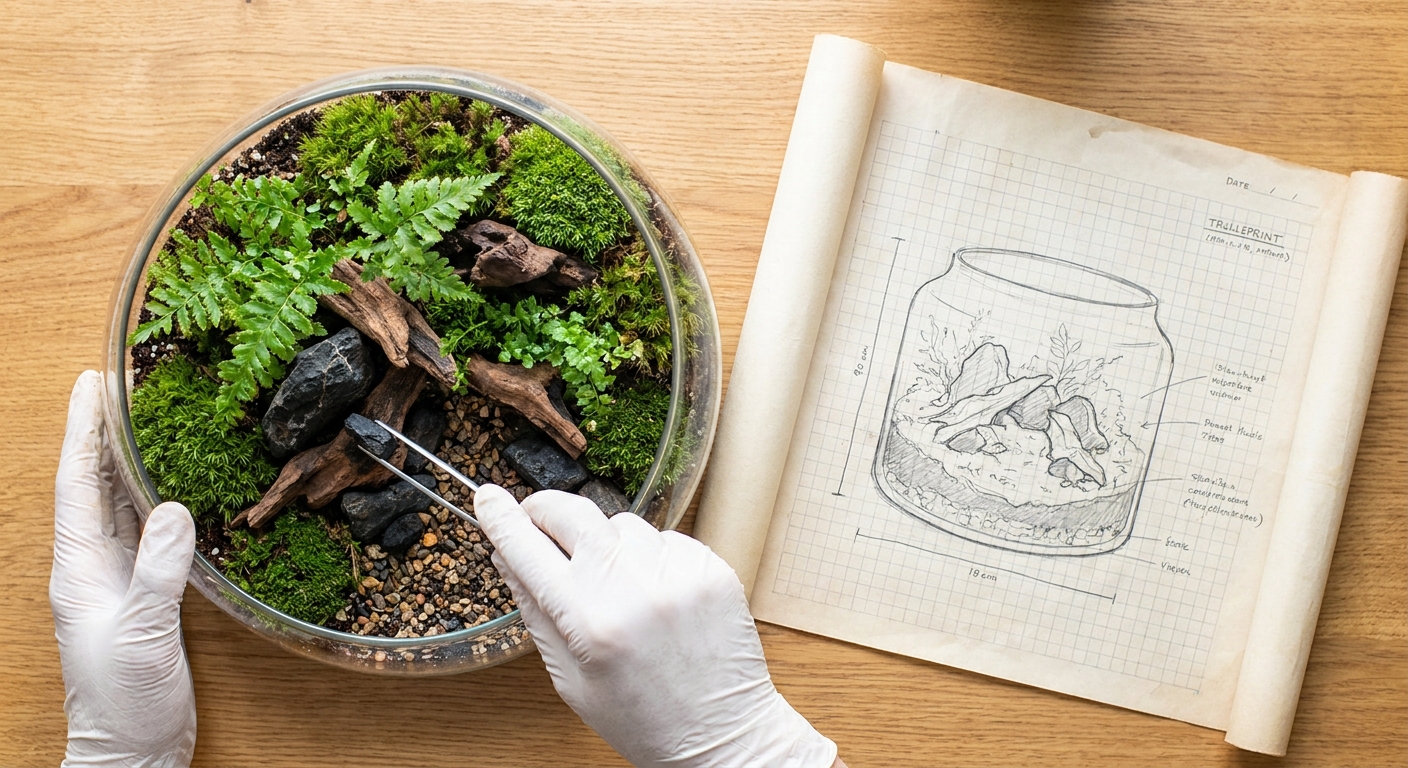
Every thriving terrarium or vivarium begins with a skeleton: the hardscape. Rock, wood, and substrate contours define where roots will wander, where moss will drink, and where condensation will pearl on the glass. Think of hardscape as topography in miniature—cliffs and ravines, ledges and forest floor, all packed into a few inches of soil.
The Skeleton of a Living Glass World
In this guide, we’ll walk through building a deeply layered, botanical-first hardscape that supports real ecological function: drainage, bioactivity, plant health, and long-term stability.
Choosing Your Hardscape Materials
Rock: The Geological Backbone
Rock brings weight, stability, and a sense of age.
Good options for terraria & vivaria:
- Seiryu stone (slightly alkaline; beautiful strata; best with plants that tolerate harder water)
- Dragon stone (Ohko) (lightweight, richly textured; perfect for mossy cliff faces)
- Lava rock (porous, feather-light; excellent for epiphytic mosses and microfauna shelter)
- River stones (smooth, grounding, good for stream edges)
Rinse or scrub stone well before use to remove dust and loose fragments. Test any unknown stone with vinegar; aggressive fizzing often signals calcareous content that can raise pH over time.
Wood: The Botanical Architecture
Wood introduces vertical movement and natural anchor points for epiphytes.
Reliable woods for humid glass setups:
- Spider wood / Azalea root – gnarled, root-like branches; ideal for canopy and rootscapes.
- Mopani – dense, heavy, sculptural; resists rot but may leach tannins.
- Manzanita – elegant, branched, long-lasting.
- Cork bark – lightweight plates and tubes; superb for arboreal spaces and background walls.
Boil or soak driftwood to reduce tannins and saturation surprises. In very humid vivaria, embrace the gradual colonization of wood by mosses, liverworts, and lichens—it’s part of the living patina.
Layering From the Glass Up: Drainage & Substrate
Step 1: The Drainage Basin
The base layer is your safety valve against waterlogging.
Common drainage media:
- Expanded clay balls (LECA / Hydroton)
- Pumice or small lava rock
- Coarse aquarium gravel (for heavier builds)
Aim for 2–5 cm depth in small terraria, more in tall vivaria. This porous layer holds excess water below the root zone, reducing anaerobic rot.
Step 2: Barrier & Biofilm Control
Place a separator between drainage and substrate:
- Non-degradable mesh (fiberglass or plastic window screen)
- Landscape fabric (inert, not fertilized)
This prevents fine particles from choking the drainage layer while still letting water flow. Over time, biofilms and microfauna will colonize these interstices, turning a simple barrier into a habitat.
Step 3: The Planting Substrate
Your substrate should mimic a forest floor more than a bagged houseplant mix.
A versatile base blend:
- 40% coconut coir or sifted peat (moisture retention)
- 25% fine orchid bark or aged hardwood chips (structure, fungal habitat)
- 15% pumice or perlite (aeration)
- 10% leaf litter, chopped (nutrient cycling)
- 10% charcoal / biochar (odor and toxin binding)
- A sprinkle of sphagnum moss fibers (moisture micro-pockets)
- Crushed eggshell or cuttlebone for isopods that need calcium
For bioactive vivaria with cleanup crews, add:
Contour the substrate: create gentle slopes, terraces around rocks, and pockets of extra depth where larger-rooted plants will grow.
Mapping the Layout: Flow, Focal Points, and Microclimates
Establish a Primary Focal Point
Before any planting, choose a single hero element:
- A tall arching root
- A jagged stone spire
- A low, mossy boulder cluster
Place this off-center, ideally near the intersection of imaginary thirds (rule of thirds). Tilt stones slightly and let wood lean or arc for a feeling of growth and tension.
Create Depth in a Shallow Space
Use these tricks:
- Large foreground, small background: Put bulkier rocks and thicker wood closer to the front; finer branches and smaller stones recede to the back.
- Rising substrate: Elevate the rear substrate to suggest distant hills.
- Overhangs and caves: Tuck rocks to create micro-caves for springtails and isopods.
Design Microclimates Intentionally
Think in gradients:
- Wet to dry: Lower depressions for moisture-loving mosses and ferns; higher ridges for Peperomia or Pilea.
- Bright to dim: Highest, most exposed faces for compact bromeliads or small orchids; shaded undersides for liverworts.
The hardscape should guide water movement (toward drainage, not glass corners) and direct light exposure across different niches.
Botanical Casting: Plants and Mosses That Love Structure
Mosses & Liverworts
Select species that grip hardscape well:
- Java moss (Taxiphyllum barbieri) – versatile, tolerates wetter conditions.
- Christmas moss (Vesicularia montagnei) – layered, conifer-like texture on rock faces.
- Cushion moss (Leucobryum glaucum) – forms bright, domed pillows on ledges.
- Riccardia chamedryfolia (coral moss) – finetextured, clings to wood and stone.
Press moss gently onto damp hardscape and mist; secure with thin cotton thread or small pieces of mesh if needed until it roots.
Terrarium-Friendly Plants
For background and height:
- Selaginella species – clubmosses for lush, ferny thickets.
- Miniature ferns (e.g., Microsorum pteropus variants, Pellaea rotundifolia in drier sections)
- Smaller orchids (e.g., Pleurothallis, Haraella retrocalla) mounted on bark.
- Peperomia (prostrata, caperata, hope) – compact foliage in crevices.
- Pilea (glauca, depressa) – trailing mats around rock bases.
- Fittonia – bright veining in consistently moist, slightly shaded zones.
- Anubias nana petite (semi-aquatic, great in paludaria)
- Cryptocoryne species (transition zones at water’s edge)
- Tiny jewel orchids in protected nooks.
For midground structure:
For foreground & edges:
Match each plant to its microclimate: roots beneath overhangs for shade lovers, slope tops for those that prefer to dry slightly between waterings.
Bioactive Foundations: Cleanup Crews in the Hardscape
A hardscape is more than decor; it’s real estate for decomposers.
Core Cleanup Crew
- Springtails (Collembola):
- Feed on mold and decaying matter.
- Thrive in moist drainage layers, bark crevices, and under leaf litter.
- Isopods:
- Options: dwarf white (Trichorhina tomentosa), powder blue/orange (Porcellionides pruinosus), dwarf purple and others.
- Shard-like stones and bark layers give them shelter.
Introduce crews after the substrate has been moistened and initial planting done. Gently tap them into the leaf litter and around rock bases.
Leaf Litter & Detritus Zones
Design deliberate decay pockets:
- Scatter dried oak, magnolia, or Indian almond leaves around stone bases.
- Fill tiny hollows behind wood with shredded leaf litter.
These zones become hubs for microfauna, steadily processing waste and nourishing your plants.
Humidity, Light, and the Hardscape’s Role
Humidity Sculpted by Structure
- Dense wood tangles and stone clusters trap humidity, making perfect hideaways for ferns and mosses.
- Open, elevated ridges dry faster, suitable for plants at risk of rot.
Monitor with a small hygrometer; most tropical terraria thrive at 70–90% humidity, with occasional ventilation to reset air quality.
Lighting the Layers
Use full-spectrum LED lighting (5,000–6,500K) above the enclosure.
- High-intensity zones: Top of wood branches, exposed rock faces – for compact, light-hungry plants.
- Medium intensity: Mid-slope structures – mosses, Peperomia, Pilea.
- Low intensity: Under overhangs and behind stone – liverworts, shade ferns.
Tilt the light slightly or use partial shading with taller hardscape to prevent harsh, flat illumination. Aim for 10–12 hours of light daily on a timer.
Long-Term Care: Letting the Layout Mature
Trimming and Guiding Growth
- Mosses: Trim with small scissors to keep contours clean; replant trimmings in bare areas.
- Sprawling stems: Nudge Peperomia and Pilea along desired paths, tucking stems behind branches or stones.
Over time, your clear structure will soften into something wilder but still readable.
Watering Rhythms
- Use a fine mist sprayer for daily or near-daily humidity support.
- Occasionally water more deeply at the substrate level, letting excess drain into the base layer; do not leave roots continually submerged.
If water accumulates visibly in the drainage layer, consider using a turkey baster to remove some.
Watching the Bioactive Balance
- A faint earthy scent and slow, clear glass fogging are signs of health.
- Persistent foul odor, thick slime, or collapsing plants suggest overwatering or poor airflow.
- Increasing ventilation periods.
- Adding more springtails.
- Reducing watering frequency and intensity.
Adjust by:
From Bones to Biome
When stone, wood, substrate, and plant are intentionally layered, a hardscape stops being scenery and becomes infrastructure—for roots, for water, for air, and for the invisible nations of microfauna beneath the leaf litter.
Take time with the bones of your build. Carve slopes, tilt branches, place each rock to shape light and shadow. Within a few months, moss will blur the edges, roots will hug the stone faces, and the glass will hold not just a composition, but a self-tending fragment of forest, built on a thoughtful, living layout.