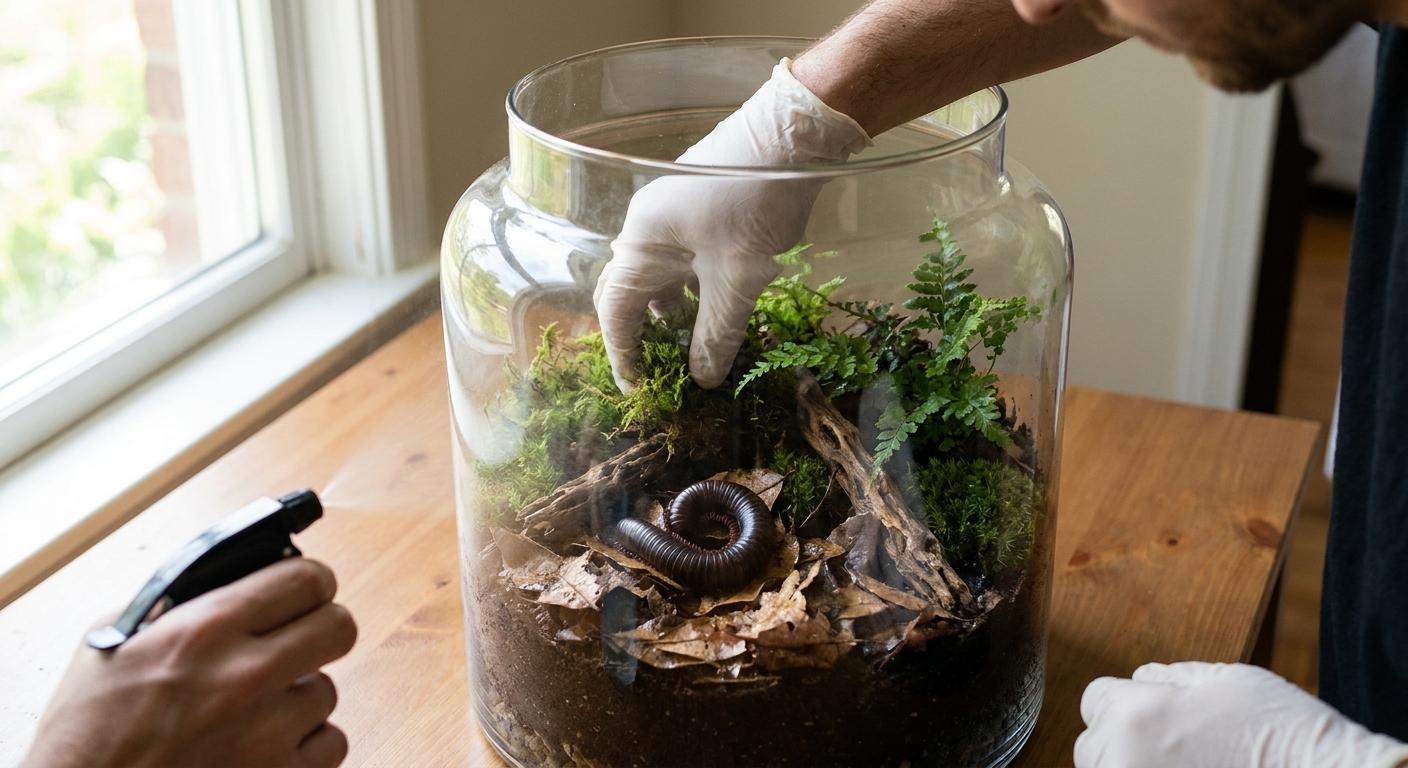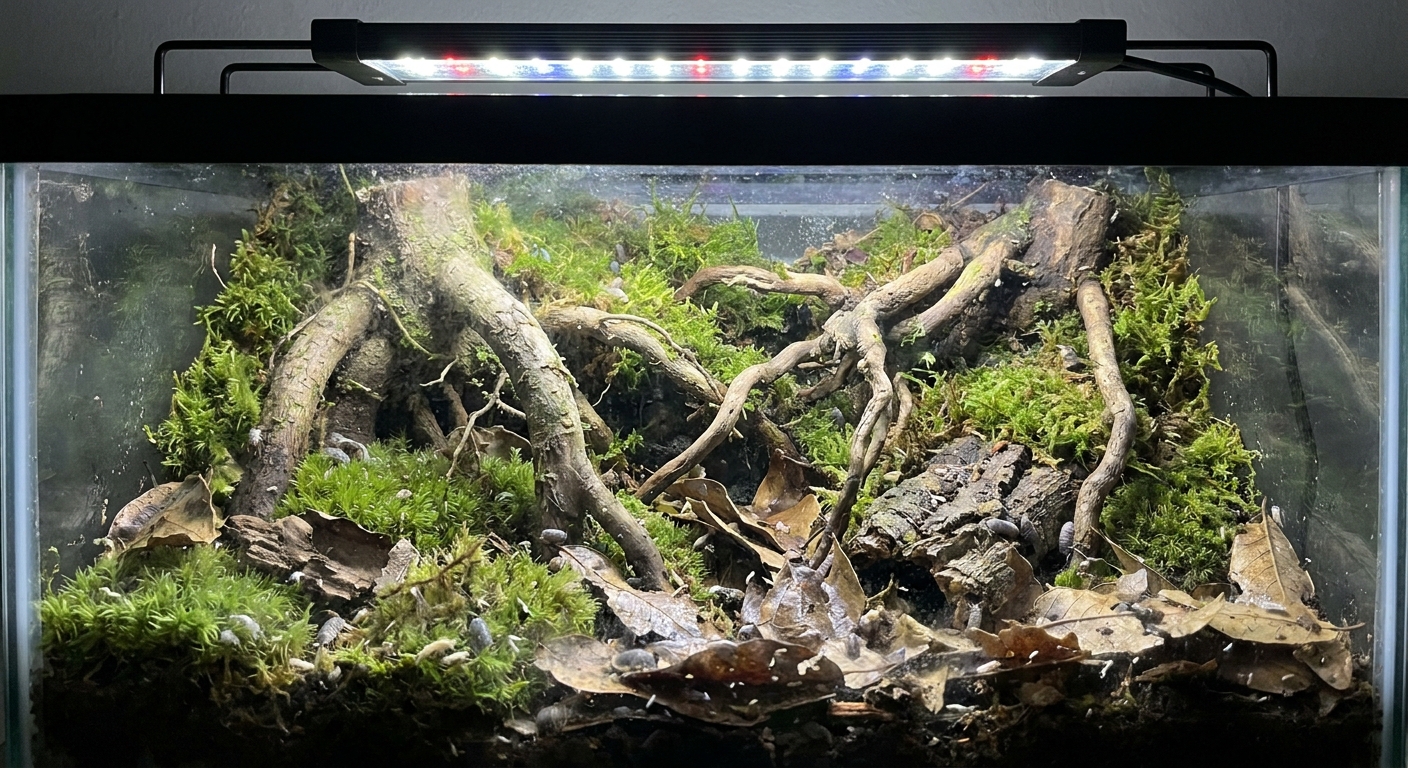
Stand in front of a well-aged bioactive vivarium and you can sense it immediately. The air behind the glass is heavier, infused with the tannic scent of damp bark and leaf mold. Mosses have thickened into cushions, creeping figs have mapped their own rivers across cork, and isopods vanish in a soft crackle of leaf litter when disturbed.
Why Mature Bioactive Systems Feel Different
This article is for keepers who already understand the basics and want to refine their craft—optimizing plant choice, sculpting with mosses, calibrating cleanup crews, dialing in humidity and light, and guiding a vivarium from “planted tank” to self-possessed ecosystem.
Designing with Plant Guilds Instead of Individual Species
In a thriving bioactive vivarium, plants function in overlapping roles, like a miniature forest. Think in guilds, not just species lists.
The Ground Layer: Shading and Soil Partners
The ground layer regulates moisture, buffers temperature, and feeds your microfauna.
Good candidates:
- Selaginella kraussiana – forms dense, fern-like mats that keep soil cool and humid.
- Ficus pumila ‘Quercifolia’ – a tiny creeping fig that stays compact and leaf-litter friendly.
- Peperomia prostrata / P. rotundifolia – trailing plants that weave between wood and stone.
- Miniature Cryptanthus and Neoregelia (terrestrial bromeliads) – rosette forms that collect water and microfauna.
Aim for 2–3 species that tolerate occasional pruning and varying humidity; let them overlap slightly to create a patchwork ground cover.
The Midstory: Structure and Shelter
This layer gives your animals cover and your eyes a focal height.
- Compact Philodendron and Rhaphidophora cultivars – heart-shaped leaves climbing wood.
- Hemionitis arifolia (Heart fern) – glossy, arrow-shaped fronds that read both botanical and sculptural.
- Pilea involucrata and P. cadierei – textured foliage that glows under LED lighting.
Plant midstory species where roots can snake deep into moist substrate, but leaves can brush the air column. Let them partially veil hides and water dishes, creating natural privacy.
The Canopy and Vertical Layer: Tapestries of Green
At the glass ceiling and back wall, you can indulge climbers and epiphytes.
- Marcgravia species – shingling vines that create living scales over cork.
- Microgramma and Davallia ferns – rhizomes that creep along bark and stone.
- Miniature orchids – Pleurothallis, Lepanthes, or Bulbophyllum species for cool, humid builds.
Mount epiphytes on cork or hardwood using a bit of long-fiber sphagnum and soft plant ties. Think like a tree branch: pockets of moss and bark where roots can cling, with intermittent wet/dry cycles.
Moss Craft: Texturing the Landscape with Living Velvet
Moss is not just filler; it’s the texture that makes a vivarium feel ancient.
Choosing Moss for Conditions
- High-humidity, warm vivaria (e.g., dart frog tanks)
- Tropical sheet moss
- Java moss on constantly damp hardscape
- Cooler, cloud-forest style setups
- Cushion moss (Leucobryum spp.)
- Haircap moss (Polytrichum spp.) in deeper, moist pockets
Avoid baking moss with intense, close LEDs. Most species prefer bright, indirect light and consistent moisture.
Establishing Moss Successfully
- Pre-soak moss in dechlorinated water for 15–30 minutes.
- Press it firmly onto already moist substrate or wood, removing air pockets.
- Mist lightly but frequently for the first few weeks, avoiding waterlogged conditions.
- Resist the urge to handle it—disturbance delays attachment.
Over time, you’ll see edges thicken and new, fresh-green growth appear. That new growth is your indicator that conditions are right.
Sculpting with Moss
Use moss to:
- Soft-edge hardscape transitions where rock meets soil.
- Create mounded "islands" that catch light and draw the eye.
- Define micro-habitats: mossy wet zones near waterfalls vs. drier, barky ridges.
The contrast between deep, velvety moss and glossy plant leaves is what gives a mature vivarium its painterly quality.
Bioactive Substrate Evolution: Letting the Soil Mature
A new substrate mix is a recipe; a mature substrate is an ecosystem.
Encouraging a Living Soil Web
Start with a robust base mix (coco/peat, bark, sand, leaf litter, and compost), then:
- Seed with springtails and at least one species of isopod.
- Add crumbled, decayed hardwood and tannin-rich leaves to feed fungi.
- Introduce mycorrhizal inoculant (from reputable sources) to partner with roots.
Over months, you’ll notice subtle changes:
- The soil darkens and becomes crumb-like.
- Fine fungal threads may appear under bark and deeper in the substrate.
- Plant growth becomes more vigorous and less dependent on added fertilizers.
Avoid constantly replacing substrate; instead, think of it as a maturing forest floor. Remove only localized problem areas (e.g., where waste has accumulated excessively) and patch rather than reset.
Calibrating Cleanup Crews for Balance, Not Just Survival
A strong cleanup crew is essential, but more is not always better. Aim for balance tailored to your specific vivarium.
Core Species and Their Roles
- Tropical springtails – excellent for continuously moist substrates; primary mold-grazers.
- Temperate springtails – better for vivaria with cooler nights or seasonal swings.
- Dwarf white isopods (Trichorhina tomentosa) – thrive invisibly in damp soils, ideal for frog setups.
- Armadillidium and Porcellio species – larger, more visible, and great at processing hefty leaf litter.
Reading Population Health
- Springtail boom: often follows a mold bloom or new wood addition; typically self-correcting.
- Isopods on glass constantly: may indicate substrate is too wet, too dry, or lacking leaf litter.
- Visible weight loss in isopods: add more decaying wood and calcium sources.
Feed sparingly. In a mature system, fallen leaves, shed skins, and traces of uneaten food often suffice. Supplement only with tiny portions of vegetable slices, fish flakes, or dried leaves.
Humidity and Lighting for Long-Term Stability
In an established vivarium, your goal is no longer just keeping things alive but avoiding swings that stress the entire system.
Humidity as a Daily Rhythm
Rather than a fixed number, aim for a pattern:
- Morning: Higher humidity, light condensation on glass.
- Midday: Slight drying as lights warm the air column.
- Night: Humidity rising again with lights off and cooler temps.
Fine-tune with:
- Adjustable vents or partially open lids to bleed off excess moisture.
- Automated misting (short, targeted bursts) for sensitive amphibians.
- Strategic hardscape: deep, mossy crevices stay humid, while exposed ridges remain comparatively drier.
Lighting: Growing Plants Without Cooking Moss
Use layered or dimmable lighting:
- Provide brighter zones directly under LEDs for bromeliads and vining aroids.
- Maintain shaded pockets where ferns and moss can retreat from intensity.
- Use timers to provide 10–12 hours of light, with gradual ramp-up/down if your fixture supports it.
Watch for cues:
- Moss bleaching or turning crisp at the edges: reduce intensity or raise the fixture.
- Vines stretching and losing leaf size: they’re asking for more light or closer placement.
Long-Term Care: Curating, Not Constantly Rebuilding
A mature bioactive vivarium should settle into a low-intervention rhythm. Your job is gentle guidance.
Regular Maintenance
- Selective pruning: Instead of hard chops, tip-prune vines and remove single older leaves from rosettes.
- Glass and vent care: Clean only the viewing panes and essential vents; leave some algae and biofilm elsewhere as part of the system.
- Leaf litter refresh: Add a thin layer when the old one has been mostly converted to humus.
Occasional Interventions
- Rebalancing species: Overly aggressive plants (like standard creeping fig) may need to be thinned or replaced with slower cultivars.
- Substrate spot-renewal: Excavate a small area if you suspect compaction or chronic dampness, replace with fresh mix, and re-seed with microfauna.
- Population corrections: If isopods proliferate wildly and start sampling live plants, reduce feeding and gently relocate some to another enclosure.
Observing the Whole System
Look at your vivarium not as separate parts but as one organism:
- Plants flagging simultaneously may indicate a lighting or root-zone issue.
- Animals spending all their time at the top or bottom may be responding to temperature or humidity gradients.
- Persistent algae on glass can signal excess nutrients or light intensity.
Adjust slowly. Allow changes a week or more to reveal their true effects before making additional alterations.
When to Start Over—and When Not To
Sometimes, vivaria go through awkward phases: temporary mold blooms, leaf-drop after a lighting change, or a plant that simply sulks.
Consider a full reset only when:
- The substrate smells strongly sour or sulfurous despite improved drainage.
- A pathogen or parasite problem can’t be controlled through targeted treatment.
- Hardscape or background materials are failing structurally.
More often, the better path is surgical adjustment—replace a problem plant, re-contour one section of substrate, or re-home a mismatched cleanup crew species.
The Art of Letting Go a Little
The most enchanting bioactive vivariums are those where the keeper has set strong initial parameters, then allowed the system to express itself.
Roots will find unexpected routes through cork. Moss will colonize the underside of branches. A single, opportunistic fern spore may germinate and claim a spotlight niche.
As you refine your plant guilds, sculpt with moss, steward your cleanup crews, and tune humidity and light, aim not for control but collaboration. The reward is a rooted realm that feels genuinely alive—an ecosystem behind glass that evolves, breathes, and thrives with only a gentle gardener’s hand.