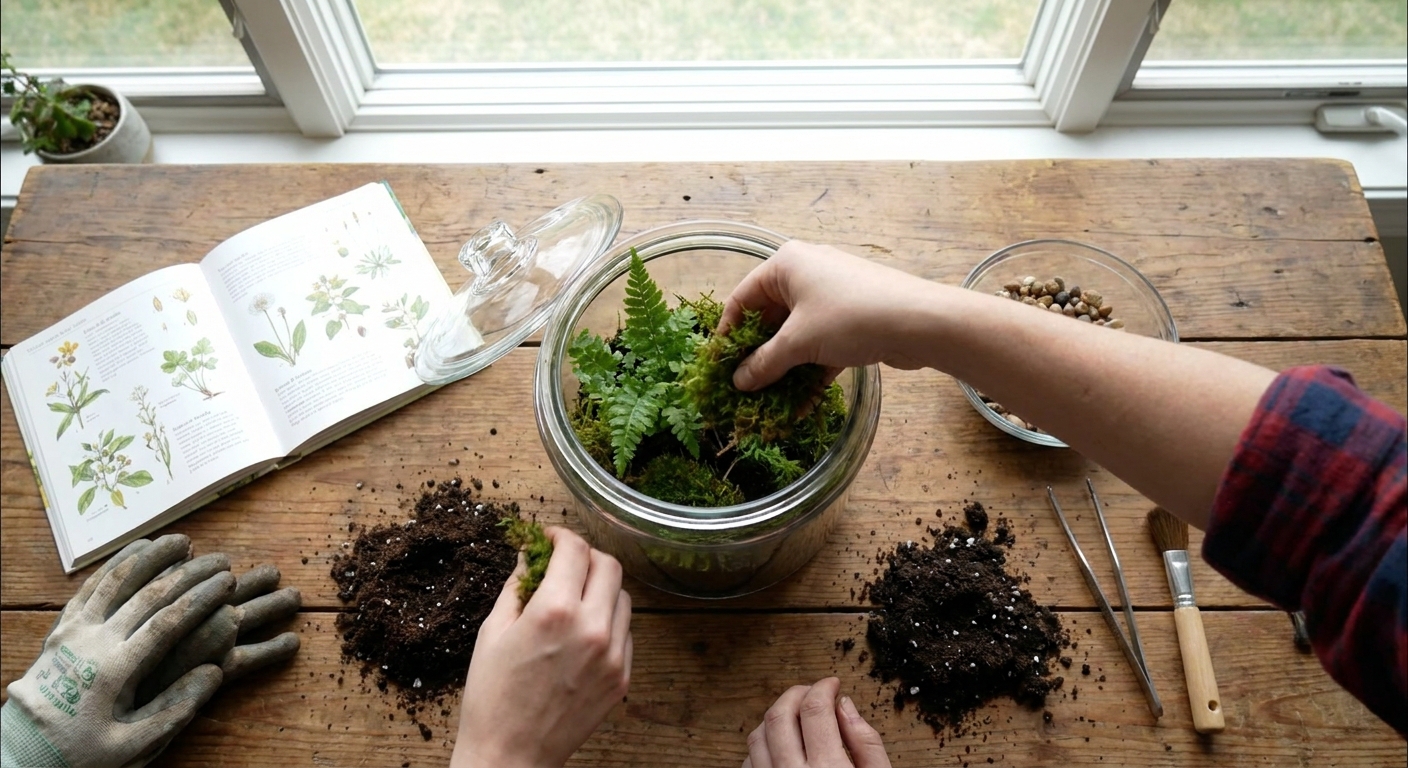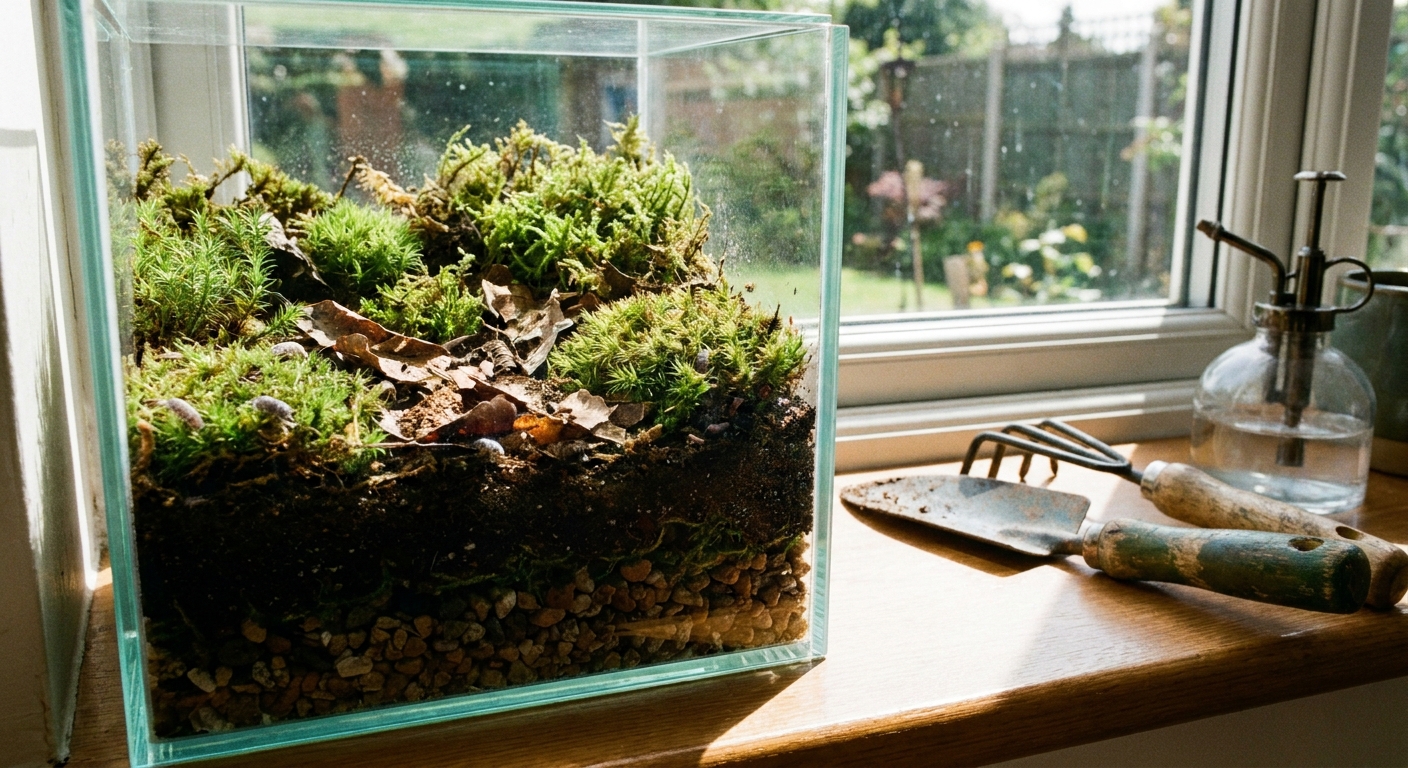
A traditional terrarium is a still-life: beautiful, contained, almost frozen in time. A bioactive terrarium, by contrast, hums quietly with process. Leaves fall and vanish, wood softens and sinks, roots constantly explore. Under the moss, a hidden web of fungi, bacteria, and invertebrates transform waste into fuel.
Why Bioactive Terrariums Feel So Alive
This article is a practical blueprint for terrarium and vivarium enthusiasts who want to build that kind of living system. We’ll walk through plant and moss choices, drainage and layering, cleanup crews, humidity and lighting, and how to keep your miniature ecosystem stable for years.
Designing for Process, Not Just Appearance
The underlying principle of bioactive design is cycling—of water, nutrients, and organic matter.
A good bioactive terrarium includes:
- Drainage architecture – to keep water moving
- Structured substrate – to anchor roots and host microbes
- Plant and moss canopy – to drive transpiration and shade the soil
- Detritivores and microfauna – to recycle dead material
- Stable climate – humidity and light that suit plants and animals alike
Think of it less as a décor piece, more as a managed woodland floor under glass.
The Layered Anatomy of a Bioactive Terrarium
1. Drainage: Where Excess Water Rests
Poor drainage is the silent killer of many terraria. Start with:
- Bottom layer (2–5 cm / ¾–2 in):
- Lava rock
- Leca (expanded clay)
- Or a mix with pumice
These porous materials store water and provide huge surface area for bacterial biofilms.
You may add a thin charcoal scatter on top to adsorb odors, but charcoal alone is not a drainage layer.
2. Mechanical Barrier (Optional but Useful)
Lay a disc of plastic mesh or landscape fabric over the drainage. This keeps soil from collapsing into the voids and keeps your layers visually distinct.
3. Bioactive Substrate: The Engine Room
You want a matrix that drains, yet clings to just enough moisture; that holds air pockets for roots and isopods, yet doesn’t dry into dust.
A balanced, field-tested blend for tropical bioactive terraria:
- 35% coco coir or peat substitute (moisture retention)
- 25% fine orchid bark (structure, fungal habitat)
- 20% pumice or lava rock (aeration)
- 10% topsoil or high-quality compost (microbial diversity)
- 10% crushed leaf litter (food and texture)
Pre-hydrate the mix: it should clump lightly when squeezed, without releasing more than a drop or two of water.
4. Leaf Litter & Microhabitats
Top the soil with a leaf litter layer 1–3 leaves deep. Choose sturdy, slow-decaying leaves:
- Live oak
- Magnolia
- Indian almond (Catappa)
Tuck small pieces of cork bark, seed pods, or gnarly twigs into the litter. These become shelter and grazing platforms for your cleanup crew.
Choosing Plants for a Dynamic, Self-Tuning Canopy
In bioactive terraria, plants do more than decorate. They:
- Consume nutrients generated by decomposition
- Draw water up from the substrate and release it as humidity
- Cast shade that stabilizes soil temperature and moisture
Traits to Look For
- Compact or creeping habit; avoid giants
- Preference for high humidity and low to medium light
- Non-toxic foliage if you plan to add animals later (e.g., dart frogs, small geckos)
Reliable Plant Groups
Ferns (for lush, forested builds):
- Microsorum diversifolium (kangaroo fern, small forms)
- Davallia fejeensis (rabbit’s foot fern)
- Philodendron scandens ‘Micans’ – velvety trailing stems
- Monstera adansonii (juvenile) – perforated leaves, good in tall tanks
- Syngonium podophyllum dwarf cultivars
- Pilea depressa – tiny round leaves, fast cover
- Peperomia caperata – corrugated leaves, loves humidity
- Fittonia albivenis – nerve plant with colored veins
- Miniature Anubias (if using a very wet or paludarium-style build)
- Small bromeliads or Tillandsia (only in open, well-ventilated designs)
Aroids and companions:
Low-growing texture plants:
Epiphytes for wood and rock:
Arrange plants in layers: taller species as a back canopy, medium growers mid-ground, creeping or rosette plants as the front understory.
Moss: The Living Mulch
Moss bridges the gap between plants and substrate, wicking moisture while softening hard edges.
Matching Moss to Conditions
- Constantly humid, closed terraria:
- Hypnum (sheet moss) – flows like a green river over contours
- Thuidium (fern moss) – delicate, fern-like fronds
- Moderately humid, partially open terraria:
- Leucobryum glaucum (cushion moss) – domes of pale green
- Dicranum (fork moss) – upright, bristling tufts
Always rinse moss gently in dechlorinated water to hydrate and remove loose debris. Press it firmly into the moist substrate or onto porous wood/rock; think of “planting” moss, not just laying it like a rug.
The Cleanup Crew: Detritivores as Gardeners
A bioactive system without detritivores is like a kitchen with no compost bin; waste accumulates and starts to smell.
Essential Microfauna
Springtails (Collembola)
- Eat mold, algae, decomposing organics
- Thrive in moist, oxygenated substrate
- Almost invisible unless you look closely at the soil surface
- Shred leaf litter and soft wood into smaller particles
- Some species are humidity-loving burrowers; others roam on the surface
Isopods (Woodlice / Pillbugs)
Recommended starter species for moist tropical terraria:
- Trichorhina tomentosa (dwarf white isopods) – tiny, burrowing, prolific
- Porcellionides pruinosus (powder blue/orange isopods) – surface-active, hardy
Seeding the System
- Add springtails by pouring a portion of their culture water onto a piece of charcoal or directly into the leaf litter.
- Gently tip isopods into the terrarium; they will disappear quickly into shelter.
- Resist the urge to overstock—give the system time to balance. They will reproduce to match available resources.
Provide a steady trickle of detritus: leaf litter, small chunks of rotting wood, and the occasional sliver of dried mushroom or fish food pellet if populations stall.
Water, Humidity, and Air Exchange
Reading the Glass
In a healthy, tropical bioactive terrarium:
- You’ll see light condensation on the glass in the coolest part of the day
- Droplets should largely clear as temperatures rise
If the glass is bone dry for days and plants wilt, you’re under-watering or over-ventilating. If it’s constantly opaque with condensation, the system is too wet or under-ventilated.
Watering Strategy
- Use dechlorinated water (aged tap, rain, or filtered) to protect microbes and moss
- Add water in small, targeted doses into the substrate, not onto leaves
- For sealed tanks, think in milliliters, not cups; a little goes a long way
Ventilation
Bioactive systems need oxygen.
- Ensure small air gaps around lids, or use a lid with adjustable vents
- In heavily planted, animal-inhabited vivaria, consider computer fan-assisted ventilation on a timer
The sweet spot is a balance where humidity stays high, but the air never feels stagnant when you open the lid.
Lighting: Fuel for Photosynthesis, Not an Oven
Your terrarium’s photosynthetic engines—leaves, moss, algae—respond directly to light intensity and duration.
Light Type
- LED grow bars or panels with full spectrum (5,000–6,500 K) work beautifully
- Avoid hot halogen or incandescent bulbs directly over glass, which can overheat the interior
Intensity & Distance
As a rule of thumb for tropical bioactive builds:
- Place LED lights 15–30 cm (6–12 in) above the glass
- Run them 8–10 hours per day
Observe and adjust:
- Moss fading or browning → too much light/heat or too dry
- Spindly, pale growth reaching upward → not enough light
A simple plug-in timer creates a consistent day/night rhythm that plants and animals can entrain to.
Establishment Phase: The First 6–8 Weeks
Think of the early weeks as a curing period, where biological relationships settle.
Week 0–2
- Expect minor mold blooms on wood and leaf litter; this is food for springtails
- Keep hands off unless growth is extreme—let the cleanup crew work
Week 3–4
- Prune any plant that rockets ahead and begins to shade everything else
- Top up leaf litter if it thins noticeably
- Adjust ventilation if condensation is consistently heavy or absent
Week 5–8
- The system should begin to stabilize: new plant growth, less obvious mold
- You may see isopods and springtails boldly foraging at dusk
Only once the microfauna populations are strong and the plants are actively growing should you consider adding small animals (if your goal is a vivarium). For plant-only terraria, this marks the point where maintenance slows dramatically.
Long-Term Care: Gardening in Slow Motion
A mature bioactive terrarium mostly asks for fine-tuning.
Regular Tasks
- Pruning & replanting: Trim back runners and tall stems; replant cuttings to fill gaps
- Litter cycling: Add a handful of dry leaves every couple of months
- Spot cleaning: Remove any obviously rotting plant that the cleanup crew cannot keep up with
Occasional Interventions
- Substrate refresh: Every 2–3 years, you may need to partially replace compacted top layers
- Population checks: If isopods boom and begin to chew live plants, reduce feeding and manually remove some individuals
Signs of a Healthy System
- Glass mostly clear, with predictable light condensation cycles
- Moss dense and richly colored, not patchy
- Leaf litter slowly thinning but never vanishing overnight
- Occasional glimpse of springtails or isopods—visible life, but not swarms
Closing Thoughts: Listening to Your Terrarium
Bioactive terrariums reward attentiveness. The more closely you watch, the more you notice: a fern crozier uncoiling in miniature, isopods filing under a fallen leaf, roots tracing bright threads against the glass.
Terrarium basics—thoughtful layering, drainage, plant and moss selection, cleanup crews, humidity, and light—are simply the vocabulary. The language itself is your daily interaction with the system: misting a little less, lifting a lid a little more, tucking a new leaf under the moss.
When you treat your terrarium as a living soil-first ecosystem, not just a décor object, it becomes what it truly is: a fragment of landscape, caught in a glass lens, quietly alive on your shelf.