Press your forehead to the curve of a terrarium and the world shrinks to a single pane of glass: beaded humidity, tiny fronds unfurling, a beetle nosing through leaf litter. This is the magic of gear and glass—simple tools and containers that allow us to build self-sustaining, botanical worlds.
The Quiet Alchemy of Glass and Green
This guide walks you through the essential equipment, plant and moss choices, layering and drainage, bioactive setups, and long‑term care needed to keep your living glass ecosystems thriving.
Choosing Your Glass: Shape, Scale, and Function
Open vs. Closed Terrariums
Open glass (bowls, rimmed cylinders, shallow dishes):
- Best for: arid or semi‑arid plants (Haworthia, Gasteria, small Sansevieria, some Peperomia)
- Conditions: higher airflow, lower humidity, faster evaporation
- Look for: wide openings for easy pruning and access
- Best for: humidity-loving mosses and tropicals (Fittonia, ferns, creeping figs, Selaginella)
- Conditions: high humidity, limited airflow, gentle temperature swings
- Look for: clear, distortion‑free glass so you can observe roots and substrate layers
Closed glass (bottles, jars with corks, lidded apothecary jars):
Useful Glass Forms
- Tall cylinders: perfect for emergent hardscape (branchy wood, upright ferns, climbing Ficus pumila ‘Quercifolia’)
- Low, wide bowls: ideal for moss gardens and intricate stonework where you want a horizontal, forest‑floor feel
- Bottles with narrow necks: visually enchanting; pair with long forceps and patience
The glass itself is a piece of gear: it dictates airflow, moisture retention, and how your hands can move inside the ecosystem.
Core Gear: Tools for Building and Tending
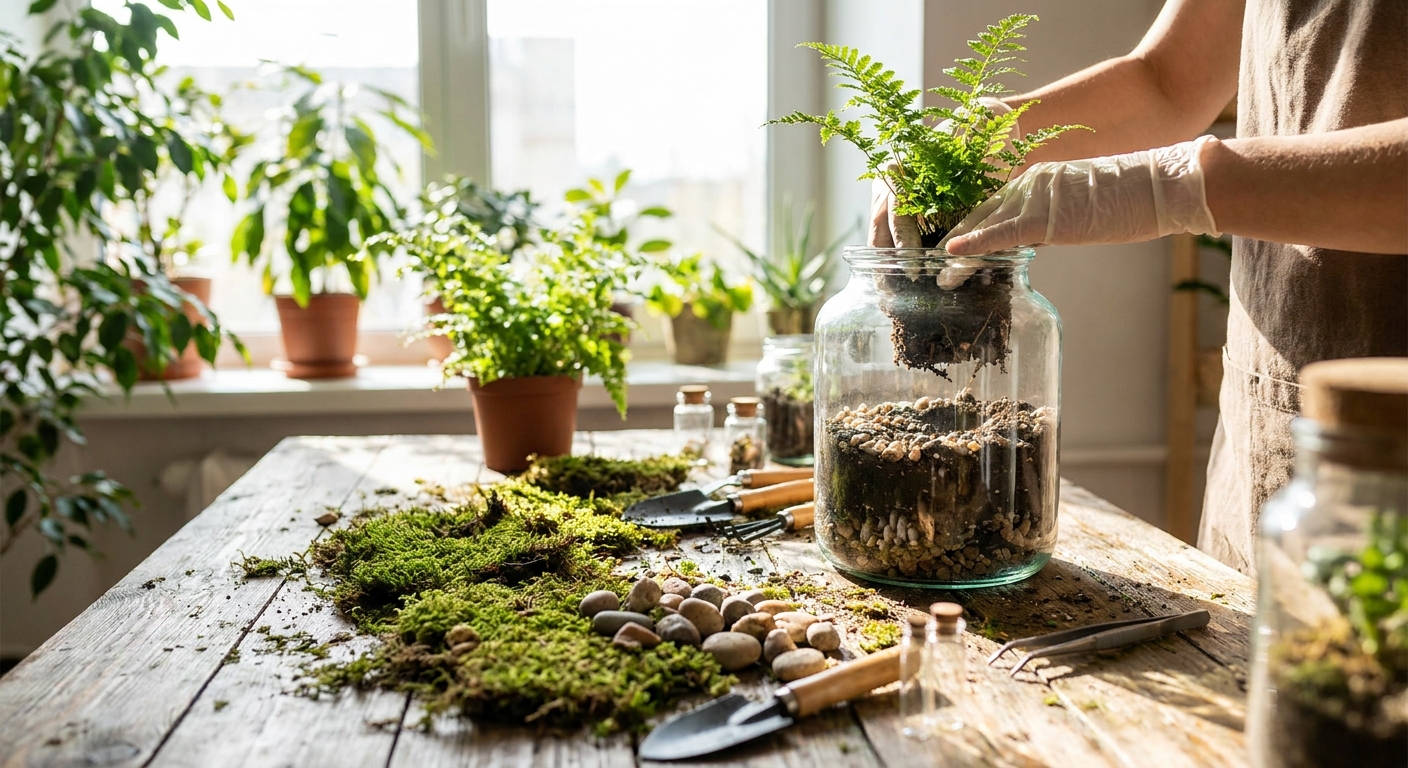
A modest tool kit turns terrarium work from awkward to joyful. Aim for:
- Long forceps or tweezers (25–40 cm): for planting in tight spaces and tucking moss between stones
- Curved aquascaping scissors: for precision pruning without uprooting neighbors
- Soft artist’s brush: to dust soil off leaves and nudge moss into crevices
- Mini funnel or paper cone: to pour substrate layers without coating the glass
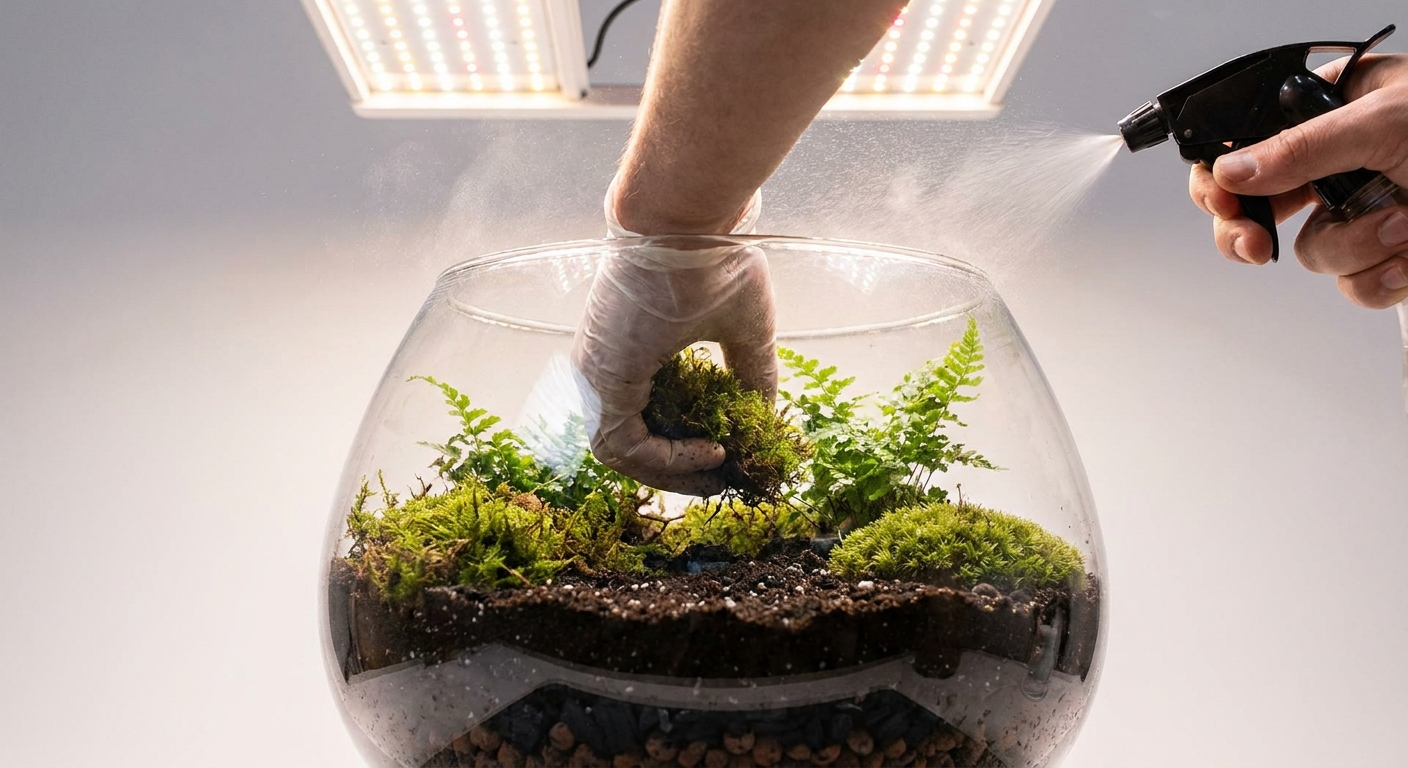
- Spray bottle with fine mist: for humidity management and gentle watering
- Turkey baster or pipette: for targeted watering at the root zone and siphoning out excess water from drainage layers
- Chopsticks or planting wands: for teasing roots into place and settling substrate
Optional but delightful:
- Hygrometer/thermometer: to confirm humidity and temperature in enclosed builds
- LED clip‑on or bar light: full-spectrum, low heat, crucial if you lack a bright windowsill
- Magnifying lens: to inspect leaves, cleanup crews, and emerging moss sporophytes
Building the Substrate: Layering and Drainage
A terrarium succeeds or fails at the root level. Think of your substrate as a layered forest floor.
1. Drainage Layer
Purpose: to catch excess water away from roots.
Best materials:
- Expanded clay balls (LECA)
- Lava rock (2–8 mm)
- Coarse aquarium gravel (for drier, open systems)
- Small jars (under 1 L): 1.5–2 cm
- Medium vessels (2–5 L): 3–4 cm
- Large displays: 5+ cm, graded from coarse at the bottom to slightly finer above
- Fiberglass window screen, fine plastic mesh, or unbleached coffee filters to prevent soil from trickling down.
Depth guide:
Top this with a barrier layer:
2. Bioactive Soil Layer
For closed, humid builds, use a soil that supports both plants and microfauna.
Base mix (by volume):
- 40% high-quality coco coir or sifted peat moss
- 30% fine orchid bark or shredded leaf litter
- 20% pumice or perlite
- 10% charcoal (horticultural or activated, rinsed)
- A handful of decaying leaves (oak, magnolia, beech) for fungal diversity
- A pinch of crushed eggshell or cuttlebone if keeping isopods (calcium source)
- 50% mineral (pumice, coarse sand, small gravel)
- 50% organic (coir/peat + bark)
Mix in:
For drier, open builds, tilt the mix:
Gently slope the soil so one side is deeper: roots explore more, and the scene feels like a landscape, not a flat tray.
3. Moss and Litter Layer
The top layer is where your terrarium becomes a forest floor.
- Sheet moss (Hypnum, Thuidium): for lush carpets
- Cushion moss (Leucobryum, Dicranum): for little hills and soft mounds
- Forest leaf litter (baked or frozen first to remove pests): for hiding spots and microfauna food
- Seedless twigs and bark: to invite fungal networks and springtail grazing
Press moss firmly into the soil so rhizoids can make contact; mist to settle.
Plant and Moss Selection: Matching Species to Glass
For Humid Closed Terrariums
Foreground plants (5–10 cm):
- Fittonia albivenis (nerve plant) – vibrant veining, loves constant moisture
- Small Peperomia species (e.g., P. prostrata, P. caperata mini forms)
- Selaginella kraussiana – feathery, almost moss‑like texture
- Miniature ferns: Pteris ensiformis ‘Evergemiensis’, Microsorum thailandicum (if space allows)
- Ficus pumila ‘Quercifolia’ – oak‑leaf creeping fig to climb wood or glass
- Anubias barteri var. nana (emerged, not submerged) – excellent for damp wood near the substrate
- Hypnum (sheet moss) – drapes over slopes and wood
- Taxiphyllum barbieri (Java moss) – can adapt to very humid, non‑submerged conditions
- Local temperate mosses from pesticide‑free sites (cleaned and quarantined)
Midground/feature plants:
Mosses:
For Open, Breezy Terrariums
Arid or semi‑arid plants:
- Haworthia cooperi and other small Haworthia species
- Gasteria minis
- Compact Sansevieria (Dracaena) cultivars
- Some Crassula and Sedum species (avoid those that want deep dormancy if conditions are warm year‑round)
Keep moss minimal or skip it in truly arid builds; mixing desert plants with lush moss generally ends in disappointment.
Bioactive Setups: Cleanup Crews Under Glass
A bioactive terrarium is more than decor; it’s a tiny, cycling ecosystem. To keep it stable, introduce detritivores—your miniature janitors.
Core Cleanup Crews
Springtails (Collembola):
- Eat: mold, decaying organics, leftover food
- Ideal for: all closed terrariums, paludariums, and humid builds
- Introduction: pour a culture directly onto the substrate; they’ll disperse on their own
- Eat: fallen leaves, decaying wood, some molds and algae
- Best species for small terraria:
- Trichorhina tomentosa (dwarf white isopods)
- Cubaris sp. minis or small Armadillidium for larger containers
- Provide: deep leaf litter pockets, decaying wood, and a small area that stays especially moist
Isopods (woodlice):
Supporting the Bioactive Web
- Add varied leaf litter: oak, magnolia, Indian almond leaves
- Introduce tiny bark chips as both food and shelter
- Avoid harsh chemicals: no systemic pesticides, fungicides, or heavily fertilized soils
Over time, you’ll see a cycle: leaf drops, isopods graze, springtails clean up the fungus, and plant roots find fresh, microbially rich soil.
Humidity and Lighting: Balancing the Glass Climate
Humidity
For closed terrariums, aim for:
- 70–95% humidity, with daily fluctuations
- Morning and evening: a light film of condensation
- Midday: glass mostly clear, especially near the top
- Heavy condensation all day, soil staying waterlogged, musty smell
- Fix: open the lid slightly for a few hours, wick out extra water with a paper towel, or use a baster to remove water from the drainage layer.
- Moss tips crisping, Fittonia leaves drooping and not recovering after a few hours
- Fix: mist sides of the glass (not just foliage), add a small amount of water at the base, ensure a good seal.
Signs you’re in balance:
Too wet:
Too dry:
Lighting
Your most important piece of gear, after the glass itself, is light.
- Provide bright, indirect light—no direct midday sun on closed glass, or you’ll cook your ecosystem
- Distance from a window: usually 0.5–2 m, depending on orientation and obstructions
- Use a full-spectrum LED (5000–6500 K) with low heat output
- Intensity: aim for 50–150 µmol/m²/s at the plant level for most closed terrariums
- Duration: 10–12 hours/day, on a timer for consistency
- Too little light: stretched stems, pale leaves, moss thinning and turning brown
- Too much light: bleached or scorched leaf patches, moss turning a dull yellow
For artificial lighting:
Plants will tell you:
Long‑Term Care: Slow Gardening Under Glass
Living glass rewards a patient, observant hand.
Weekly to Monthly Tasks
- Visual inspection: look for yellowing leaves, fungal blooms, or pests
- Wipe glass: use a soft cloth or sponge to remove algae and mineral spots from the inside; avoid soap
- Pruning: trim back over‑eager stems with curved scissors; remove any rotting leaves promptly
- Leaf litter top‑ups: add a few new leaves for isopods and springtails when the old ones are mostly skeletonized
Seasonal Adjustments
- In winter, when indoor air is drier, closed systems may stabilize beautifully, but open bowls might need more frequent misting or a supplemental humidity tray nearby.
- In summer, watch for overheating; move terraria further from south‑facing windows, increase airflow around the glass, and shorten light durations if using powerful LEDs.
When to Intervene Deeply
- Persistent mold on hardscape despite springtails: reduce moisture, increase air exchange, and consider removing heavily affected pieces.
- Plants pressing hard against the lid: time for a gentle trim or a transplant into a taller vessel.
- Substrate sour smell: siphon out excess water, open the terrarium to breathe for a day or two, and consider partial substrate replacement.
Closing the Loop: Glass as a Botanical Lens
With the right gear—thoughtful glass, layered substrates, simple tools, and a diligent cleanup crew—you’re not just making decoration. You’re curating a slow, botanical performance: condensation and evaporation, growth and decay, roots scribing quiet arcs through soil.
Start with one vessel, learn its rhythms, then expand. A shelf of terraria becomes a library of climates: cloud forest, mossy ravine, shaded understory. The gear is simple; the glass is clear. What happens inside is endlessly, restlessly alive.